How to use comments & notifications in Datawrapper

In Datawrapper, you can leave comments and reply to comments from team members in all the visualizations you share with them in your workspace. This article explains how.
How to write and format a comment
How to edit, delete, and link to a comment
How to react to a comment with emojis
How to reply to a comment
How to close and reopen comments
How to be notified about comments
How to write and format a comment
To write a comment, open the editor of any visualization, then click on Comments in the upper right of the editor. This opens the comments sidebar. Here you can write or reply to comments:

To write a new comment, simply start typing in the text box at the bottom of the Comments sidebar. To send your comment, click on the little send icon next to it, or press Ctrl/Cmd + Enter.
To mention a team member in a comment, type @ and the name of your team member. You'll see suggestions. Choose any of them, then press Enter:

You can also format your text, add links, bullet lists, and more. You'll find all the options in the formatting bar that appears when you select text:

The following tables explains what each icon does, and gives alternative ways to get there:
| Options | Instructions | Example |
Bold |
Select text and press Ctrl/Cmd+B.
Or select the bold B in the formatting bar. Or use Markdown: **text** or __text__ |
This is very important. |
Italic |
Select text and click Ctrl/Cmd+I.
Or select the italic I in the formatting bar. Or use Markdown: *text* or: _text_ |
Instead of this , let's do that. |
Strikethrough |
Select the T with a line through it in the formatting bar.
Or use Markdown: ~~text~~ |
We should use |
Link |
Simply paste it and it will be clickable.
Or select text, then select the chain icon in the formatting bar. Paste your link, then press Enter. |
How about data from here? |
Quote |
Select the quote icon in the formatting bar.
Or use Markdown: Type > followed by a space, then type the quote. Press Enter twice to escape the quote. |
I was referring to Maria here:
The colors should be less saturated |
Bullet list |
Type a hyphen/dash (-) followed by a space and your list item.
Or select the bullet list icon in the formatting bar. Press Enter to create a new list item. Press Enter twice to escape the list. |
The following needs more love:
|
Numbered list |
Type a number followed by a dot and a space (e.g. "1.") and your list item.
Or select the numbered list icon in the formatting bar. Press Enter to create a new list item.Press Enter twice to escape the list. |
Here's the plan:
|
Inline code |
Select the inline code icon in the formatting bar.
Or use Markdown: `text` |
Try using a <br> instead. |
Code block |
Select the code block icon in the formatting bar.
Or use Markdown: Type ```, then press Enter. To escape the code block, press Enter three times. |
Here's my trick:
<b style="color:#eee">Note:</b> |
How to edit, delete, and link to a comment
To edit a comment you've already sent, hover over it, click on the three dots and then click on Edit. You'll also find the option to delete your comment in this menu. This only works for comments you've written yourself.

To link directly to a comment – no matter if you or somebody else wrote it –, hover over it, click on the three dots and then Copy link.
How to react to a comment with emojis
To react to a comment with an emoji (like 👍 for "okay", 🙏 for "thank you", or ✅ for done", hover over the comment you want to react to, then click on the little emoji icon to the right of a comment. Now you can select an emoji:

To remove the emoji reaction, click on it.
To react the same way as somebody else on a comment, click on the emoji reaction that somebody else chose.
How to reply to a comment
To react to a comment, you can use threads. These let you reply directly below a top-level comment, even if it's not the latest one. To start a new thread, click on a comment. You can also hover over the comment you want to reply to, then click on the little reply icon to its right. Both will open a text box directly below the comment.

In a thread with more than three replies, only the newest three ones will be shown. You can click on Show x more replies to see the full thread:

How to close and reopen comments
If you have a big discussion about a visualization, we recommend to close comments that are not needed anymore. This hides them from the comment sidebar. Only still-to-be-discussed ("open") items are shown.
To close a comment, hover over it (it must be a top-level comment!), click on the three dots to its right and then on Mark as closed. If you do so, the comment will disappear from the visible comments. Closing a comment with a thread closes all comment in the thread, too.

To see all closed comments, click on Open comments on the top and select Closed comments instead. To see all comments – closed and open ones –, select All comments instead.
To re-open comments, click on Mark as open, and they'll appear in your Open comments again.
How to be notified about comments
Whenever you create a visualization or comment on one, you become subscribed to notifications for all comments on it. That means you'll be notified whenever somebody replies, reacts, or comments on such a visualization. You'll also be notified if a teammate mentions you in a comment or if you are invited to a workspace or team. You can change your subscriptions:
- To get notifications even for a visualization you've neither created nor commented on, open the visualization editor, click on comments, and on Subscribe right below it.
- To not get notifications anymore for a visualization you've created or commented on, click on Unsubscribe.
Datawrapper will always inform you about new notifications through the notification center and you can choose to receive further alerts in your emails and via Slack. Read on to see how.
Notification center
The notification center will always alert you to any new notifications. You can access it via the inbox tray button in the navigation bar:

From the notification center, you can jump directly to a comment by clicking on it. If you hover over it, you'll also see the option to mark it as read, unsubscribe from all notifications about the visualization, or delete it.

You can also mark all your notifications as read with check box at the top, or delete them all by clicking on the three dots and then choosing Delete all notifications.
Email notifications
You can also choose to receive notifications via email, in addition to the notification center alerts:
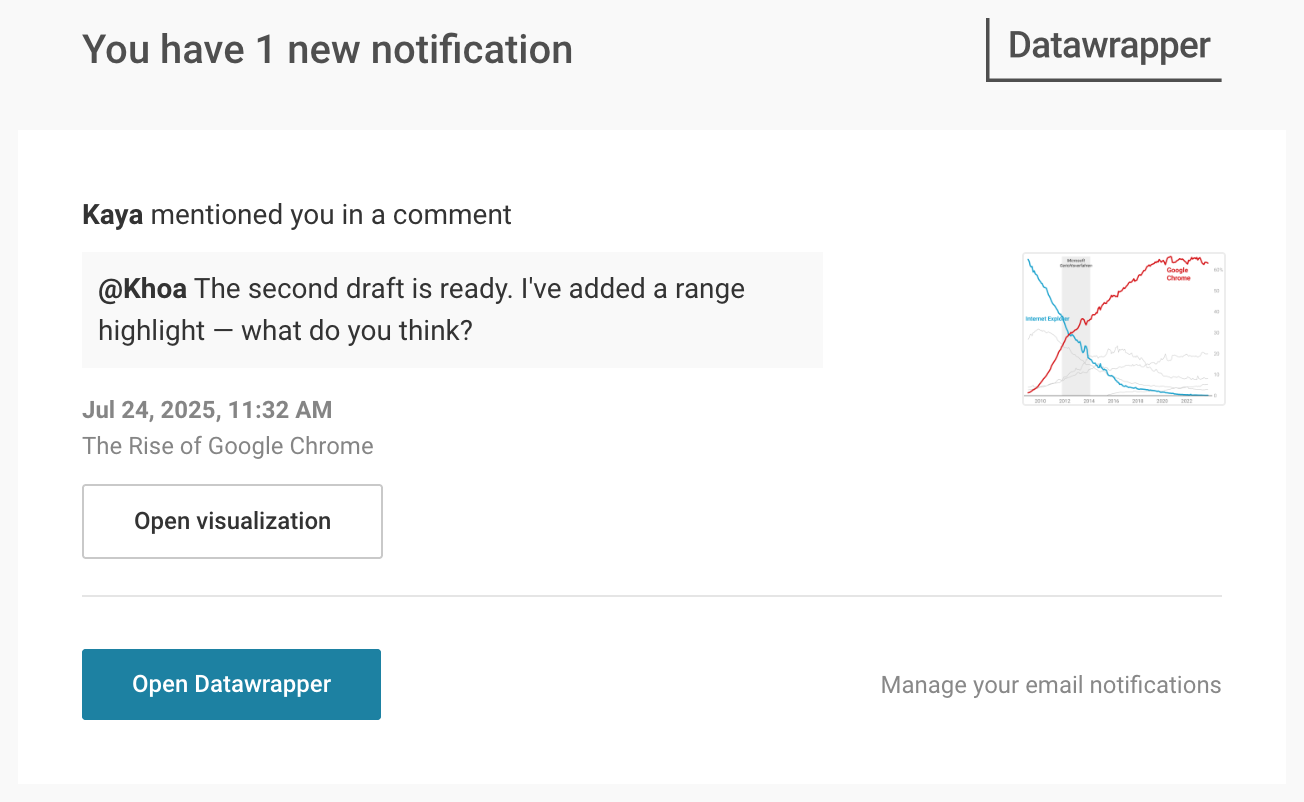
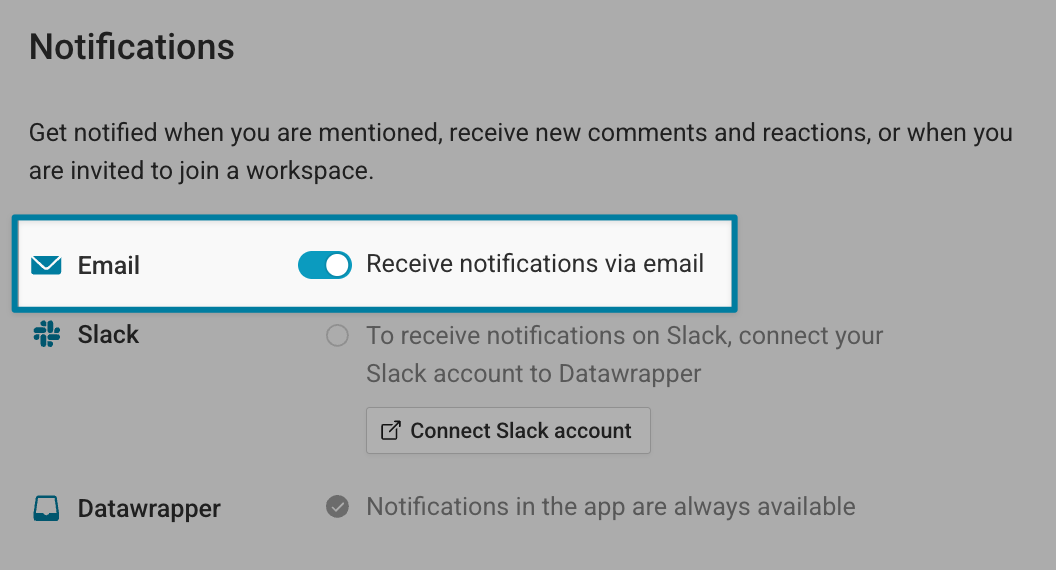
To activate this option, simply go to your account settings and in the Notifications section, switch on the Receive notifications via email toggle:
Slack notifications
⚠️ There are currently two Slack integrations in Datawrapper. This one allows you to receive a Slack notification whenever you are mentioned, receive new comments and reactions, or when you are invited to join a workspace. This is an account-level setting, which must be activated individually. The other Slack integration is a team setting which will notify you in a Slack channel of your choice whenever a chart in your workspace or team is published or republished.
Similarly, you can connect your Slack account if you'd like to receive notifications there. In your account settings under the Notifications header, click on the Connect Slack account button:
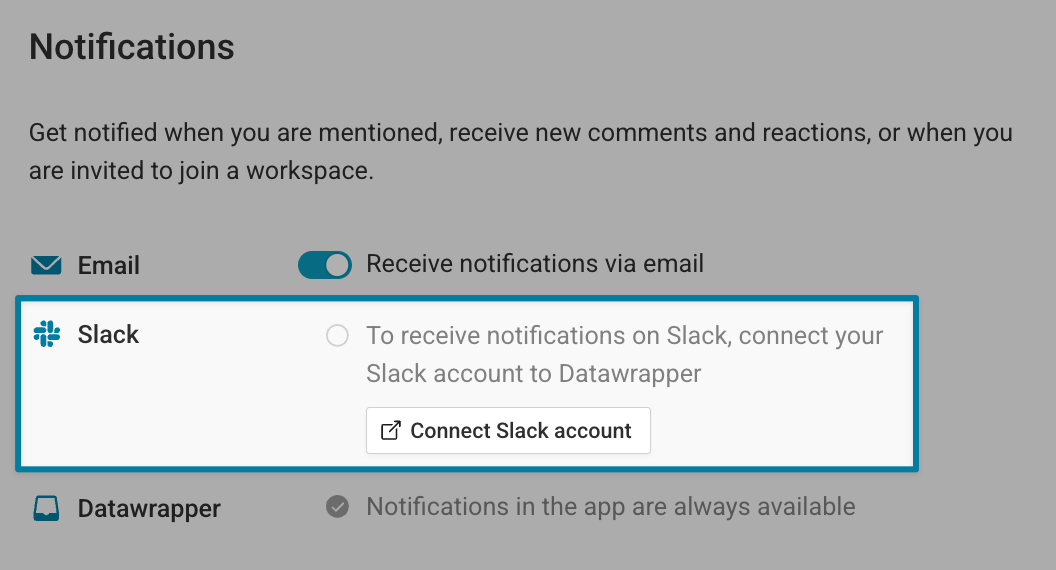
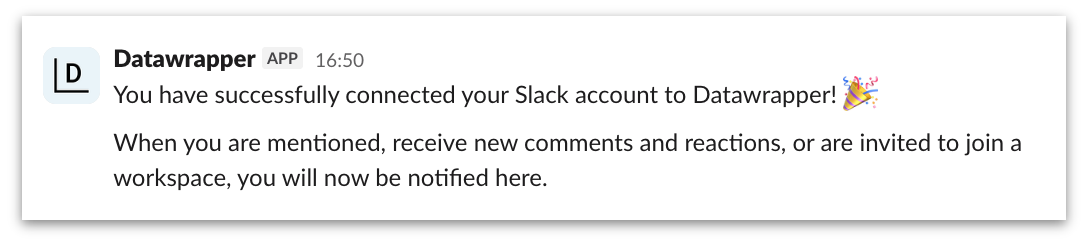
This will take you to an external page where you will be prompted to install the Datawrapper app in your Slack workspace. After following the steps and successfully connecing your account, you will receive a Slack message from the Datawrapper app:
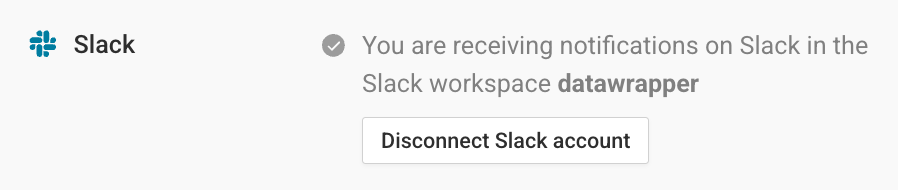
You can disconnect your Slack account from Datawrapper at any time by clicking on Disconnect Slack account in your Datawrapper notifications settings: